

Did you know more than 5000 companies are listed on the BSE and about 2000 on the NSE? Yes, you heard that right. Now for an average investor, it is only possible to invest in some of the stocks so how do you pick the best ones for your portfolio? And more importantly, how do you avoid the pitfalls, i.e., the stocks that may look attractive but are not? Check out this blog to learn the red flags you come across while analysing a stock for investment.
Read More: How is money made in the stock market?
Why is it important to analyse a company before investing?
Before moving on to the red flags mentioned above, let us first know why it is important to analyse a company before investing in its stocks. Analysing a company allows the investors to primarily understand the business of the company and thereby the factors that can impact its stock prices. This primary understanding of the company’s financials also helps evaluate if its stock is overvalued or undervalued, further providing insights into the investor's potential entry and exit points. Analysing a company before investment allows the investors to assess if such investment is in line with their risks and return expectations leading to a sound investment portfolio.
What are the top red flags in analysing a company’s stock?
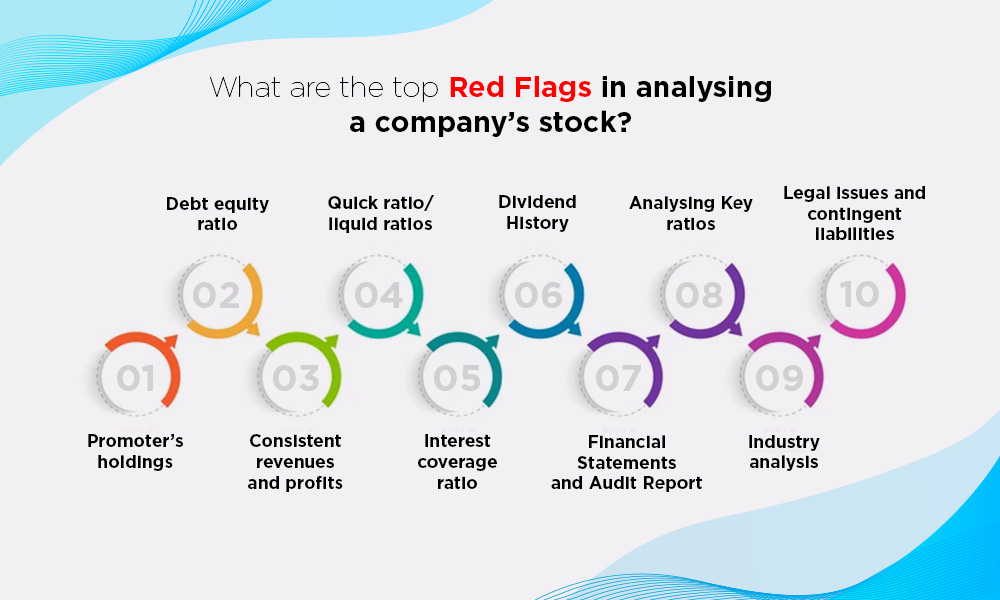
Promoter’s holdings
Examining the promoter's holdings is a critical step for investors. High promoter ownership not only signifies confidence in the company but also ensures alignment of interests between management and shareholders. We have seen many concerns about corporate governance in the past, therefore, a substantial promoter stake is often viewed as a positive indicator. Conversely, a decreasing promoter holding may raise concerns about the promoters' commitment to the company's success, potentially signalling caution for investors.
Analysing Key ratios
Investors should pay meticulous attention to key financial ratios. The price-to-earnings (P/E) ratio is particularly crucial as it provides insights into the market's perception of a company's future earnings potential. Additionally, analysing earnings per share (EPS) and return on equity (ROE) is essential. A high P/E ratio might suggest overvaluation, while a healthy ROE indicates efficient use of equity. These ratios provide valuable benchmarks for investors navigating the dynamic Indian stock market.
The other key ratios that investors need to focus on are highlighted here.
Consistent revenues and profits
India's economic landscape is dynamic, and companies need to adapt swiftly to market changes. Investors should be wary of companies experiencing sudden declines in revenues or profits, as these may be indicative of broader economic challenges, shifts in consumer behaviour, or management issues that could impact long-term performance.
Debt equity ratio
Understanding a company's debt-equity ratio is crucial for assessing financial risk. Given the sensitivity of Indian markets to global economic trends, companies with high debt levels might face challenges during economic downturns. A balanced or low debt-equity ratio is often preferred by investors as it indicates a more stable financial structure and resilience in the face of economic uncertainties.
Interest coverage ratio
The interest coverage ratio holds significance for investors due to its susceptibility to the impact of interest rates and inflation on corporate profitability. When the interest coverage ratio is low, it raises apprehensions about a company's capacity to meet its debt obligations. Given the unpredictable nature of interest rates, investors are advised to scrutinise this ratio diligently to assess the financial robustness and stability of the companies in their investment portfolios.
Quick ratio/ liquid ratios
Analysing the quick ratio is crucial for assessing a company's short-term liquidity and its capacity to meet immediate financial obligations without relying on inventory sales. A low quick ratio is a significant red flag to watch out for as it may signify potential difficulties in covering short-term debts. This can lead to liquidity challenges and financial distress threatening the survival of the company. Investors should carefully consider industry benchmarks and specific business contexts when interpreting a low quick ratio, as it can serve as a warning sign of a company's vulnerability to economic downturns or unexpected financial pressures.
Financial Statements and Audit Report
Analysing financial statements and audit reports is essential for investors to gain a comprehensive understanding of a company's financial health and performance. Financial statements provide insights into key metrics and cash flow management, while audit reports conducted by independent auditors ensure the accuracy and reliability of the financial information presented. A critical red flag to avoid during investment analysis is the presence of irregularities, discrepancies, or qualified opinions in financial statements and audit reports. Such issues may indicate mismanagement, fraud, or weaknesses in internal controls, jeopardising the credibility of the company's financial information and posing risks for potential investors. Thorough scrutiny of these documents is crucial for making well-informed investment decisions and mitigating the potential impact of unreliable financial reporting.
Dividend History
Examining dividend history is crucial for investors as it offers insights into a company's financial stability and commitment to shareholders. A consistent and growing dividend track record typically indicates a financially robust and established company, showcasing its ability to generate sustainable earnings. This, in turn, reflects management's confidence in future cash flow. Conversely, an irregular or declining dividend history may raise concerns about financial health, earnings volatility, or changes in management priorities. A history of abrupt dividend cuts or suspensions is a significant red flag when analysing a company for investment. These factors may suggest financial difficulties or an unsustainable dividend policy of the company which may not be favoured by risk-averse investors especially those seeking a more or less stable source of passive income.
Industry analysis
Analysing industry trends is essential for investors as it provides vital context for evaluating a company's performance within its market. Understanding industry dynamics helps investors identify opportunities, assess risks, and make informed decisions based on factors like market demand and competitive forces. Companies failing to have an alignment with industry standards are seen as a potential red flag for investment. Companies that appear disconnected or fail to adapt to changing market conditions may struggle to sustain growth and profitability. Investors should be cautious of firms that do not demonstrate an awareness of, or response to, industry shifts.
Legal issues and contingent liabilities
Analysing legal issues and contingent liabilities is essential for investors to evaluate the potential financial risks associated with a company's legal challenges and obligations. This scrutiny provides insights into the company's transparency, regulatory compliance, and exposure to legal risks that could impact its financial stability. A high level of undisclosed or underestimated contingent liabilities is a significant red flag during investment analysis as it may suggest a lack of transparency or an attempt to downplay financial risks. Investors should exercise caution if a company fails to adequately address legal matters or if there's uncertainty regarding potential financial obligations tied to legal issues.
Conclusion
Analysing a company’s financial health is a primary step in the investment process. Identifying the potential red flags in this process and thoroughly understanding the same help the investors in eventually creating a robust investment portfolio.
This article talks about the pitfalls in a company’s financials and policies that may signify or highlight the risk of investment in a company. Let us know if you have any further queries related to this topic or need further information on the same and we will address them.
Till then Happy Reading!
Read More: Real-Time Stock Market Data Plugin from Trusted Data Vendor In India
Frequently Asked Questions
Which red flag should investors prioritize first when analysing a company—high debt, declining profits, or falling promoter holding?

Thank you for raising this important question! There is no single red flag that should always be prioritised, as high debt, declining profits, and a falling promoter holding can signal different types of risk. Investors should first look at whether these warning signs are persistent and whether multiple red flags are appearing together, while also considering the company’s cash flows, business model, and industry. We hope this approach helps investors assess potential risks more thoughtfully rather than reacting to a single indicator.
The faqs are helpful to all my basic queries about this topic.
Thank you for your feedback. We are glad to know that the FAQs helped address your basic queries and made the topic easier to understand. We appreciate your support.
Well-written article with useful insights. Every investor should be aware of these warning signs before investing.
Thank you for your kind words! We are glad you found the article useful. Stay tuned for more interesting content on TrueData!
Very informative read! Thanks truedata
Thank you for taking the time to comment on our blog ! Glad you found it informative.
Much needed blog. Keep posting interesting articles
Thank you, we appreciate your encouragement and will keep sharing more interesting articles!
Interesting
Thanks for appreciating our work! Watch this space for more informative content on TrueData!
nice
Thank you, Sir!
excellent. Your blog topics are excellently optimized.
Thank you so much for appreciating our work! We are glad the blog resonates so well with you! Keep reading and engaging for more quality content.
Great.. The best blog I found from long search.. Thanks sir
Thank you so much for your kind words! We are glad you found the blog interesting!