


The fundamental characteristic of stock markets is the constant swing of the ebb and surge. While this gives seasoned investors opportunities to invest in quality stocks, it also keeps conservative investors away from investing in stocks. Enter debt investments! While traditional debt investments include investment in government bonds, debt mutual funds offer a diverse investment option where investors can invest in multiple debt investments through a single fund. Learn all about debt mutual funds in this article to know why you should have them in your portfolio.
What are Debt Mutual Funds?
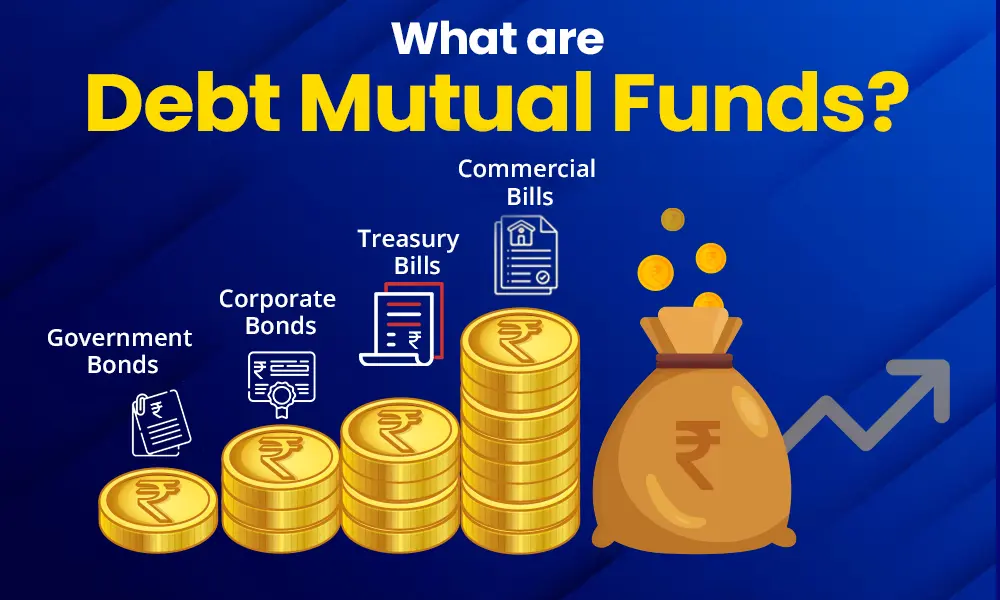
Debt mutual funds are a fundamental category of mutual funds that invest primarily in fixed-income securities. These securities include government bonds, corporate bonds, treasury bills, and other money market instruments. Debt funds are less volatile than equity mutual funds, offering a more conservative investment option for investors seeking stable investment options with more or less fixed income while conserving capital investment. These funds come with a fixed maturity based on the securities the fund has invested in and are not affected much like the equity funds due to the market volatility.
How do Debt Mutual Funds work?

Debt mutual funds like any other mutual fund pool the money from many investors and use the combined funds to invest in fixed-income securities. These bonds promise to pay a fixed interest amount over a specific period. The fund earns interest from these bond securities, which forms the return for investors. The goal of debt mutual funds is to provide a stable and predictable return through the interest earned, while also protecting the principal amount from large fluctuations.
Debt funds invest in both listed and unlisted debt instruments, such as corporate and government bonds, and generate returns through appreciation in their Net Asset Value (NAV) and periodic interest from these instruments. The NAV of the fund changes daily, reflecting both interest income and changes in the market value of underlying assets. When interest rates fall, the value of debt securities with higher coupon rates rises, leading to an increase in the fund's NAV. Additionally, any changes in the credit ratings of the debt securities can impact the NAV. Thus, debt funds are similar to fixed deposits in terms of regular interest income, but their returns fluctuate with market conditions.
Types of Debt Mutual Funds
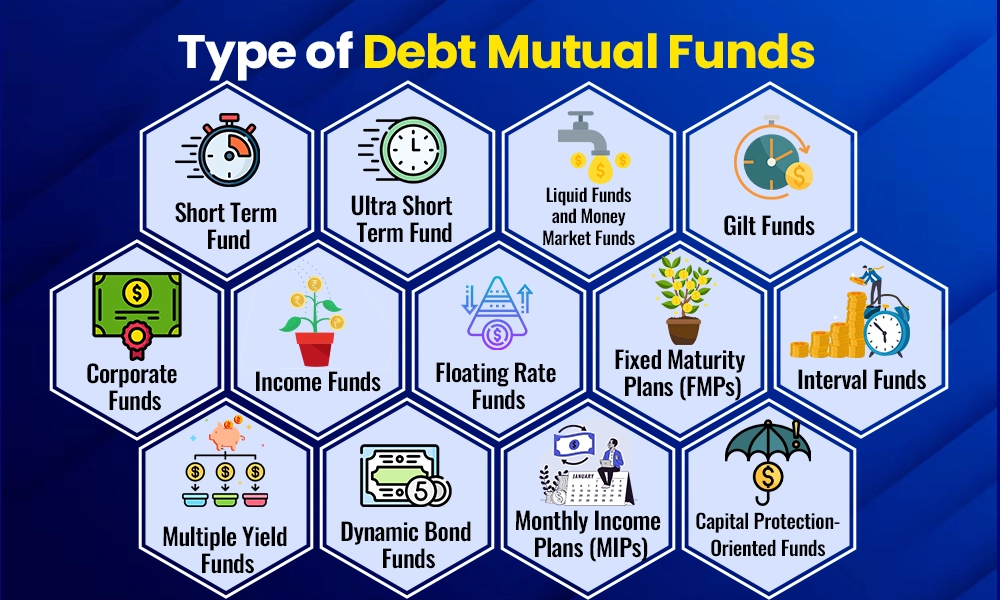
Debt funds are further categorised into different types of funds based on the securities they invest in and the maturity period of such securities. This classification of debt mutual funds as per AMFI is explained below.
Short Term Funds
Short-term debt funds invest in securities with a maturity period between 1 to 3 years. They aim to provide stable returns while minimising interest rate risk. These funds are suitable for investors looking for low-risk investments over a short period, offering better returns than savings accounts or fixed deposits.
Ultra Short-Term Funds
Ultra short-term funds invest in securities with a maturity period ranging from 3 to 6 months. These funds aim for slightly higher returns than liquid funds while maintaining low risk and quick liquidity. They are ideal for investors with a very short investment horizon, seeking better returns than traditional savings.
Liquid Funds and Money Market Funds
Liquid mutual funds invest in very short-term securities with maturities of up to 91 days, such as treasury bills and commercial papers, providing high liquidity and low risk. Money market funds invest in short-term money market instruments, offering similar liquidity and returns, making them suitable for parking surplus cash for immediate financial needs.
Gilt Funds
Gilt funds invest exclusively in government securities (G-Secs) with varying maturity periods. Since these bonds are issued by the government, they carry minimal credit risk. These funds are suitable for risk-averse investors who want safety, though returns can be affected by interest rate movements.
Corporate Funds
Corporate bond funds invest at least 80% of their assets in high-rated corporate bonds. These funds aim for higher returns than government bonds by investing in corporate debt, offering moderate safety. They are ideal for those seeking steady income with slightly higher risk than government securities.
Income Funds
Income funds invest in a mix of short-term, medium-term, and long-term debt securities to provide regular income or passive income over time. These funds are actively managed, and the portfolio can be adjusted based on market conditions. They are suitable for investors looking for consistent income and are comfortable with some level of interest rate risk.
Floating Rate Funds
Floating rate funds invest primarily in bonds with variable interest rates that change based on market conditions. This means the returns adjust according to prevailing interest rates. These funds are ideal for investors who want protection from interest rate fluctuations while earning regular income.
Fixed Maturity Plans (FMPs)
Fixed Maturity Plans are closed-ended funds that invest in debt securities with a fixed maturity date. Investors lock in their money for a specified period, and the returns are aligned with the maturity of the underlying securities. These funds are ideal for those who want predictable, stable returns and are willing to stay invested for the entire tenure.
Interval Funds
Interval funds are mutual fund schemes that blend features of both open-ended and closed-ended funds. These funds invest in short-term or long-term debt securities and are suitable for investors looking for periodic liquidity. Interval funds are open for buying and selling only during specific transaction periods (STPs) at pre-determined intervals. Between these intervals, they function like closed-ended schemes and are listed on stock exchanges. However, unlike traditional closed-ended funds, interval funds do not have a fixed maturity date, allowing investors to stay invested indefinitely, similar to open-ended schemes.
Multiple Yield Funds
Multiple yield funds invest in a combination of debt and equity instruments to provide a mix of stable income from debt securities and potential capital appreciation from equities. These funds are suitable for investors seeking balanced returns with moderate risk.
Dynamic Bond Funds
Dynamic bond funds have a flexible investment strategy, allowing the fund manager to change the portfolio’s duration and types of debt securities depending on market conditions. This strategy allows the fund to adjust to interest rate fluctuations, offering higher return potential for investors comfortable with moderate risk.
Monthly Income Plans (MIPs)
Monthly Income Plans are hybrid funds that primarily invest in debt securities but also hold a small portion in equities (usually 15-25%). They aim to provide regular income through dividends and some capital appreciation. These funds are ideal for conservative investors looking for steady income with a small equity exposure.
Capital Protection-Oriented Funds
Capital protection-oriented funds invest primarily in AAA-rated bonds and similar debt securities to safeguard the invested capital while a smaller portion is invested in equities to generate potential growth. These funds are structured to protect the principal amount, making them suitable for conservative investors with low-risk tolerance.
What are the factors to consider while investing in Debt Mutual Funds?
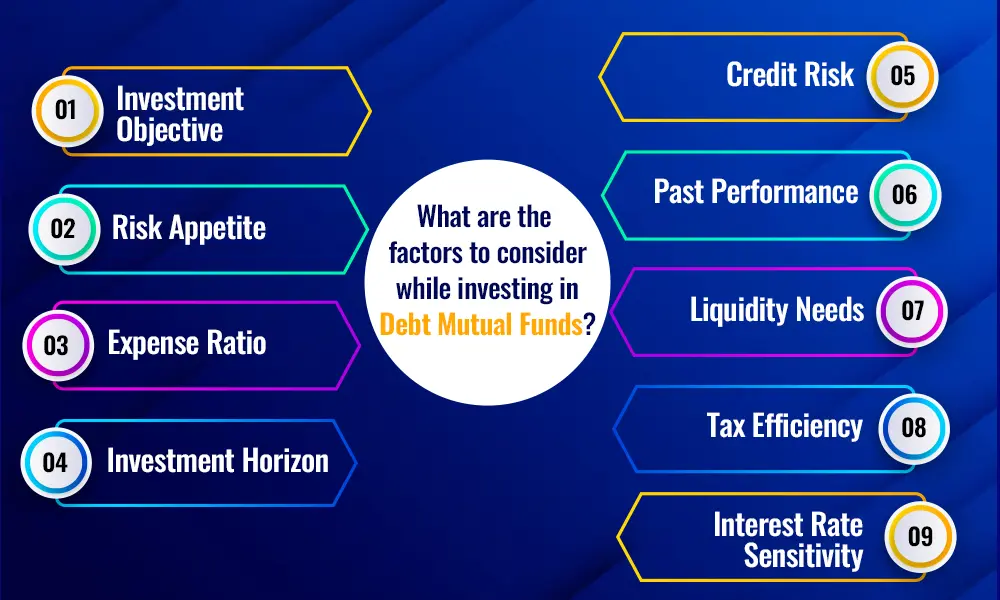
Debt mutual funds are increasingly becoming a preferred choice for investment especially by investors who seek returns higher than traditional savings or fixed deposits while also stressing capital protection. But does that mean all debt funds are good? The key question, particularly for novice investors is how do you choose quality debt funds? Here are some of the factors that investors need to focus on while choosing debt mutual funds.
-
Investment Objective - Investors should ensure the debt fund aligns with their financial goals, whether it is for short-term needs, income generation, or long-term capital preservation.
-
Risk Appetite - While debt funds are generally safer than equity funds, they still carry risks like interest rate risk and credit risk. Investors should choose funds that match their risk tolerance.
-
Expense Ratio - The cost of managing the fund, known as the expense ratio, can affect returns. Investors should compare this across funds, as lower expense ratios typically result in better net returns.
-
Investment Horizon - The duration for which investors plan to stay invested is crucial. For short-term goals, funds with shorter maturities like liquid or short-term funds are suitable, while long-term investors might prefer dynamic or income funds.
-
Credit Risk - The quality of the underlying debt instruments is important. Investors should check the fund’s portfolio for credit ratings of securities to ensure low default risk.
-
Past Performance - While past performance is not a guarantee of future returns, checking the same can give insights into how it has managed risk and delivered returns in different market conditions.
-
Liquidity Needs - Some debt funds like Fixed Maturity Plans (FMPs) or Interval Funds may have lock-in periods, so investors should choose funds based on their need for liquidity.
-
Interest Rate Sensitivity - Debt fund returns are impacted by interest rate movements. Investors should consider how sensitive the fund is to rate changes to make informed investment decisions. The general rule for debt funds is that longer-duration funds are more impacted by interest rate changes than shorter-duration ones.
-
Tax Efficiency - Taxation is a big factor to consider as it impacts the net returns from the fund. Investors should, therefore, stay updated on the latest tax structure before investing in debt funds.
How are Debt Mutual Funds Taxed?
The returns from debt funds can be in the form of dividends, interest income and capital gains at the time of redemption of the units. Investors are liable to pay tax on these returns from the fund based on the provisions of the Income Tax Act, 1961 and the applicable amendments of the same.
Taxation of Interest income and Dividend Income from Debt Funds
The interest income and dividend received from the equity portion of the fund are taxable in the hands of the investors and taxed at the applicable slab rates under the head ‘Income from Other Sources’.
Taxation of Capital Gains from Debt Mutual Funds
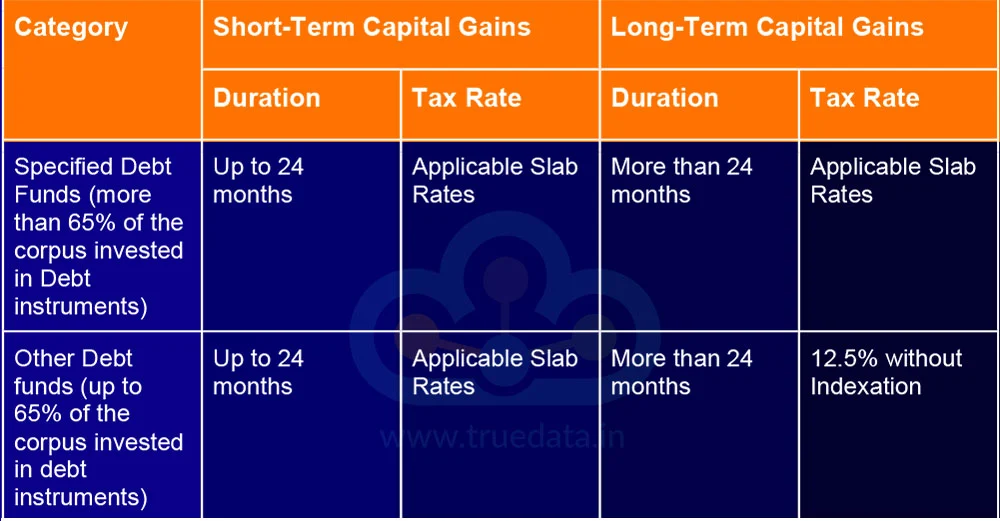
The Budget 2023 introduced a modified tax structure for debt funds based on the investment of its corpus in debt and equity. Accordingly, the specified mutual funds which invested more than 65% of their corpus in debt instruments were taxed at applicable slab rates of the taxpayer without the benefit of indexation irrespective of the holding period.
The Budget 2024 brought further changes in the capital gains taxation and the holding period for long-term capital gains has been reduced from 36 months to 24 months and the LTCG rate from 20% with indexation to 12.5% without indexation benefit. This revised duration is applicable to all funds (specified debt funds and others), however, the specified mutual funds will be taxed at the applicable slab rates as per the amendments of Budget 2023.
The taxation of capital gains from debt mutual funds post Budget 2024 is explained in a simplified manner in the table given below.
Who Should Invest in Debt Mutual Funds?

Debt mutual funds are ideal for investors who are looking for safer investment options with relatively stable returns compared to the stock market. These funds suit individuals who prefer lower risk and aim to preserve their capital while earning more than traditional savings accounts or fixed deposits. Debt funds are also a good choice for those with short to medium-term financial goals, such as building an emergency fund, saving for a down payment, or generating a steady income during retirement. Investors who are not comfortable with the volatility of equity markets or who want to diversify their portfolios with fixed-income instruments can benefit from debt mutual funds. Additionally, these funds provide flexibility and liquidity, allowing investors to withdraw money when needed, which makes them more attractive for those seeking both stability and convenience in managing their savings.
What are the Benefits and Limitations of Investing in Debt Mutual Funds?
After all the essential details of debt mutual funds let us now address the prime question of why should you invest in debt mutual funds while also focusing on the cautions to be considered. Here is a brief gist of the benefits and limitations of investing in debt mutual funds to make informed investment decisions.
.webp "Benefits and Limitations of Investing in Debt Mutual Funds")
Conclusion
Debt mutual funds can be an excellent investment choice for those seeking stable returns, capital protection, and regular income while enjoying professional management and diversification. They offer various options to suit different investment goals and risk tolerances, making them suitable for both conservative and moderate investors. However, investors should also consider the limitation of investing in debt mutual funds to have a robust investment portfolio to achieve their financial objectives.
This article talks about debt mutual funds in detail to help investors increase their knowledge of these investment vehicles and make informed investment decisions. So what do you prefer as an investor - Debt Mutual Funds or Equity Mutual Funds? Let us know your thoughts or if you need further information on this topic.
Till Then Happy Reading!
Read More: Types and Benefits of a Systematic Withdrawal Plan (SWP)
Frequently Asked Questions
A clear and helpful guide to understanding debt mutual funds

Thank you for your feedback. We’re glad you found the guide clear and helpful for understanding debt mutual funds.
A well-explained article on debt mutual funds. The breakdown of liquid, gilt, corporate bond, short-term, and other debt fund categories makes it easier to understand the different investment options.
Thank you for your detailed feedback. Glad you found the breakdown of different debt fund categories clear and useful for understanding the available investment options.
A well-written article for conservative investors. Including a few case studies or return scenarios could make it even more engaging.
Thank you for your valuable feedback! We're glad you found the article useful. Adding case studies and return scenarios is a great suggestion, and we'll consider including them in future updates to make the content even more practical and engaging.
Good Basics. Keep Sharing
Thank you for appreciating our work! We will continue sharing more informative content on TrueData!
Nice post.
Thank you for appreciating our work!
Nice topic. Just bookmarked your blog
Thank you so much, Sir! We are really glad you found the topic and the blog interesting, and truly appreciate you bookmarking us for future reads. Stay tuned for more exciting content, and feel free to let us know if there is a specific topic you would like us to cover. We would love to hear your suggestions!
Overall, coming across this hidden online treasure has been a highlight of my day, and I look forward to exploring more of what justpaste.it has to offer in the future.
We truly thank you for appreciating our work! Such inspiring words are what keep us going in our mission to make this blog better every day! Stay tuned for more interesting content and keep sharing your thoughts with us!