


'Mutual funds' - A generation of investors has grown up listening to these words. While mutual fund returns are one of the prime factors that attract investors, they also get a few tax benefits that add to the mutual funds' attraction. However, given the multiple changes in mutual fund taxation in past budgets, let us take a comprehensive review of mutual fund taxation to make informed investment decisions. Check out this blog to learn all about the taxation of mutual funds and how recent changes have impacted investors.
Taxable Returns from Mutual Funds
Before we move on to the taxation of mutual funds, let us focus on the various forms of returns (income or gains) from mutual funds.
Dividend Income and Interest Income

Mutual funds invest in a diverse pool of assets that include stocks, debt, and investing in gold, etc. These assets can generate income in the form of dividends from stocks or interest income from debt instruments.
Dividends provide an additional income stream for mutual fund investors and are paid from the fund's accumulated distributable surplus. These payouts occur at the fund’s discretion and are therefore not considered to be a stable or fixed source of income. Furthermore, prior to the Amendment in Finance Bill 2020, dividends received from mutual funds were tax-free in the hands of the investors. However, after the amendment, they are included in the taxable income of the investors and taxed at applicable slab rates.
Interest income, on the other hand, is considered to be a more stable or regular source of income as debt instruments give interest on the investment at set intervals which is declared at the time of issuing the instrument. This interest income too is taxable in the hands of the investors at applicable slab rates. Certain debt funds also invest in tax-free bonds or similar debt instruments where the interest received on such instruments is not taxable for investors and thus provides tax benefits.
Capital gains

The other form of returns from mutual funds is the capital gains received from the sale of units of the fund. The amount in excess of the purchase price of the units of the fund is considered to be capital gains which are taxable in the hands of the investors based on two important factors, namely, the type of fund and the period of holding of the units. Similarly, capital loss (which is the loss incurred on the sale of the units of the fund) can be set off and carried forward for a period of 8 years provided they are duly filed in the Income Tax Return.
How are Mutual Funds Taxed?
The recent changes to the Income Tax Act, 1961 in the Budget of 2024 have revised the capital gains taxation on dual aspects, i.e., the applicable tax rates and the tenure for capital gains calculation. Here is a detailed explanation of the mutual funds taxation for the three primary categories of mutual funds based on the type of asset they invest in.
Equity Mutual Funds
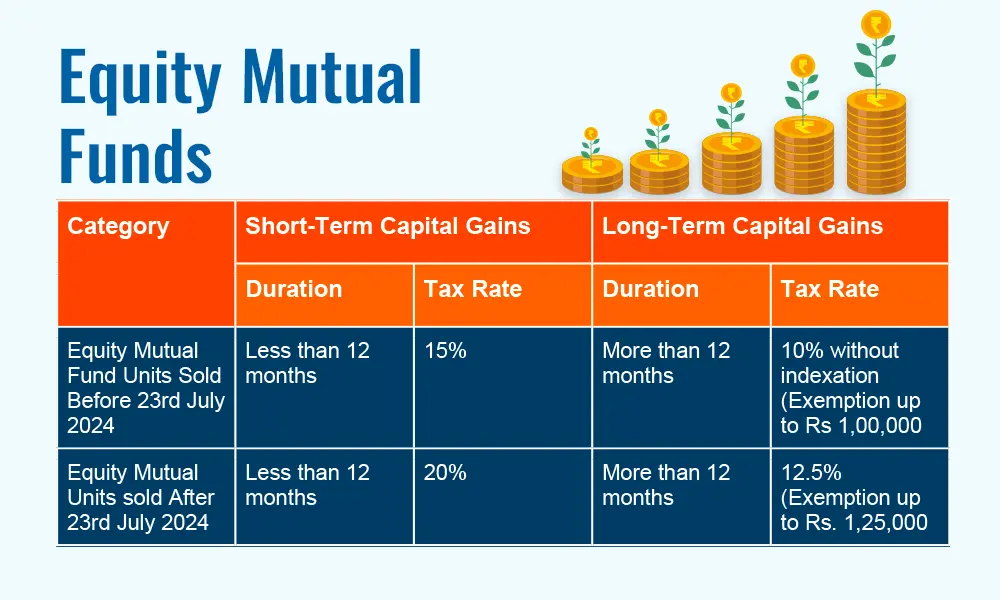
Equity Mutual funds invest primarily in Indian stocks or equities and equity-related instruments, i.e., a minimum of 65% of the fund corpus. These funds are further classified into various types based on the equities they invest in and the scheme objective, for example, Large-Cap funds, Mid-Cap funds, ELSS (tax saving funds), Flexi-Cap funds, Sectoral Funds, Value Funds, etc.
As mentioned above, Budget 2024 amended the tax rates for equity mutual funds as well as the minimum exemption limit available for capital gains on the sale of units of equity mutual funds. The details of the same are tabled hereunder.
Debt Mutual Funds
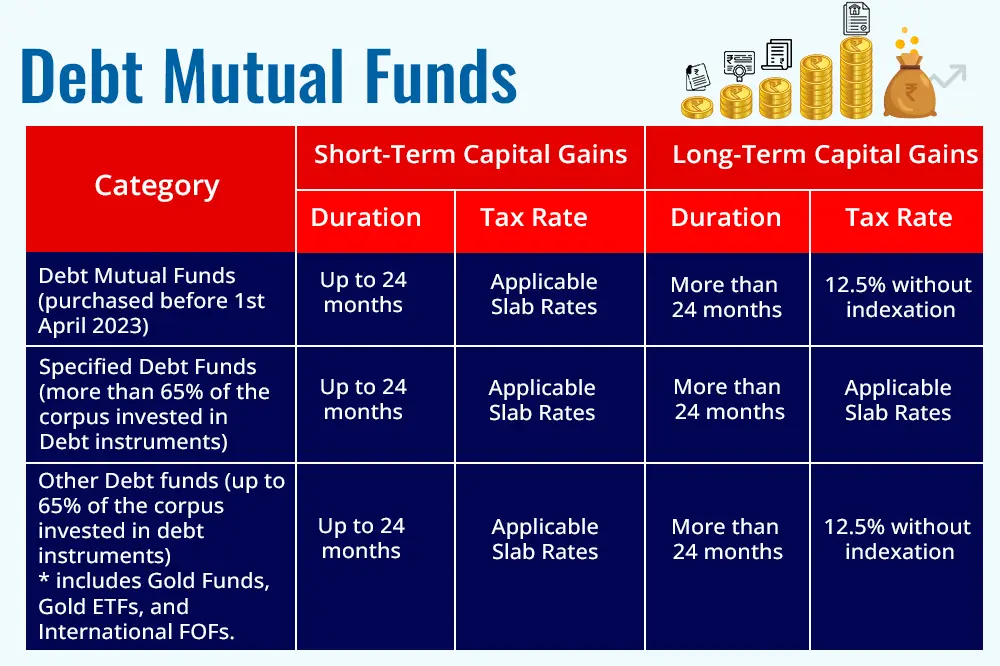
Debt mutual funds invest primarily (at least 65% of the corpus) in a variety of debt instruments like government bonds, treasury bills, commercial papers, corporate bonds, etc. Some of the classic examples of these funds include gilt funds, corporate funds, floater funds, liquid funds, and more.
Before Budget 2023, debt mutual funds in India were taxed based on the duration they were held by the investors. Gains from units held for less than 3 years were considered short-term and taxed at the investor's income tax rate, while gains from units held for over 3 years were taxed at a lower long-term rate of 20% with the benefit of indexation. This benefit allowed investors to adjust the purchase price for inflation thereby lowering their net taxable amount on long-term gains.
Budget 2023 created a special category for debt mutual funds that invested more than 65% in debt instruments and took away the benefit of long-term capital gains tax rates. Gains from these funds are now taxed at the applicable slab rates of investors irrespective of the holding period and no indexation benefits.
Budget 2024 further simplified the rules for all funds lowering the holding period for long-term gains from 3 years to 2 years. Furthermore, the long-term gains are now taxed at a flat 12.5% without indexation benefit. However, the specified debt funds from Budget 2023 (those with over 65% in debt) will still be taxed at the applicable slab rates of investors irrespective of the holding period.
These changes were introduced to simplify the taxation process and make it more equitable for investors. However, they have also impacted the attractiveness of debt mutual funds as an investment option compared to other financial instruments by bringing them at par with similar and traditional fixed-income investment options like fixed deposits.
Here is a summary of the debt mutual fund taxation as per the latest applicable rules.
Hybrid Mutual Funds
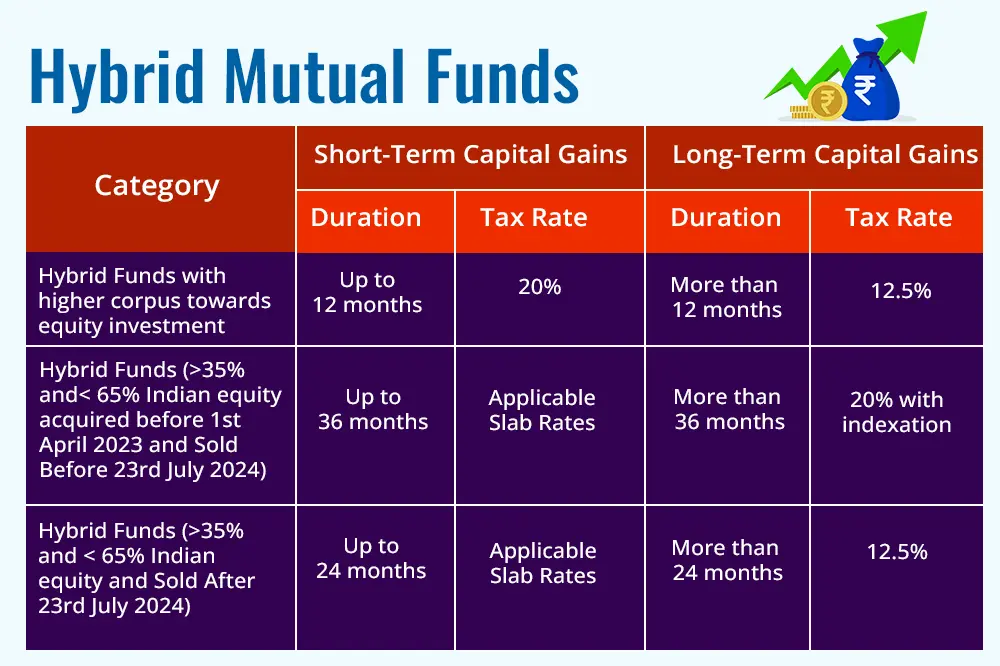
Funds that invest in a mix of debt and equity instruments between 35% and 65% of the fund corpus are classified as hybrid mutual funds. These funds aim to balance the risk and return from equity and debt funds, thereby providing maximum benefits to investors of both types of investment options. The types of hybrid mutual funds include conservative funds, balanced funds, arbitrage funds, aggressive hybrid funds, etc.
The taxation of these funds depends on their asset allocation. If the fund has a higher investment in equity instruments, it is classified as an equity-oriented hybrid fund and taxed like equity mutual funds. Similarly, hybrid funds with a higher investment in debt instruments are classified as debt-oriented hybrid funds and taxed like debt funds.
The summary of taxation for hybrid mutual funds is tabled below.
Conclusion
The taxation of mutual funds has undergone significant changes in the past couple of years. These amendments in the rate of taxation and reduction in the holding period are an attempt to make the process simpler and more uniform across fund categories. However, the changes in mutual fund taxation have made certain categories less attractive, especially with the withdrawal of the indexation benefit. Therefore, investors have to understand these changes effectively and how they will impact their investment decisions to make informed decisions and ultimately have a profitable portfolio.
This topic talks about the latest changes in the mutual fund taxation arena and how they have impacted investors. What do you think of these changes? Are they a welcome change for you or not? Let us know your thoughts on this topic or any queries that you have and we will address them.
Till then Happy Reading!
Read More: Pros and Cons of Mutual Fund Investing
Frequently Asked Questions
Very Informative Post

Thank you for your encouraging feedback! Stay tuned for more informative content on TrueData!
Nice blog
Thank you so much !
Taxation in mutual funds explained clearly
Thank you, glad we could simplify the concept for our readers!
The explanation of dividend taxation and capital gains taxation was straightforward and easy to follow.
Thank you for your feedback! We are glad you found the explanation easy to understand. Knowing how dividend income and capital gains are taxed can help investors plan their mutual fund investments more effectively and avoid surprises at tax time.
Many articles discuss mutual fund returns but rarely explain taxation in detail. This article fills that gap quite well.
Thank you for your kind feedback! We are glad you found the article useful. Taxation plays an important role in overall investment returns, and understanding these rules can help investors make more informed mutual fund decisions.
Taxation often gets overlooked when people calculate returns. This is a useful reminder
Thank you for your feedback! You are absolutely right, taxation is often overlooked when evaluating investment returns. Understanding the tax impact can help investors get a more realistic picture of their actual gains and make better investment decisions.
I Like your Mutual funds blogs, It covers all the mutual funds basics
Thank you so much for such encouraging feedback! Stay tuned for more exciting and simplified content on diverse topics!
Looking forward to more articles like this that demystify complex taxation and trading concepts.
Thank you! We’re glad you found it helpful, we’ll keep sharing more easy to understand articles on such topics.
Excellent topic mam
Thank you for your valuable feedback! Stay tuned for more interesting content on TrueData!
Helpful.thanks
Glad you liked our work! Watch this space for more quality content on TrueData!
Excellent post.. keep sharing
Glad you liked our work Sir! Let us know your thoughts on our other topics too. We are looking forward to hearing more from you!
thanks for sharing this excellent post. very informative
Thank you for appreciating our work! Keep reading and engaging with TrueData for more valuable insights on diverse topics!
Good topic. i was actually searching for how much capital gain is taxfree??
Thank you, Sir! Glad you liked the post!